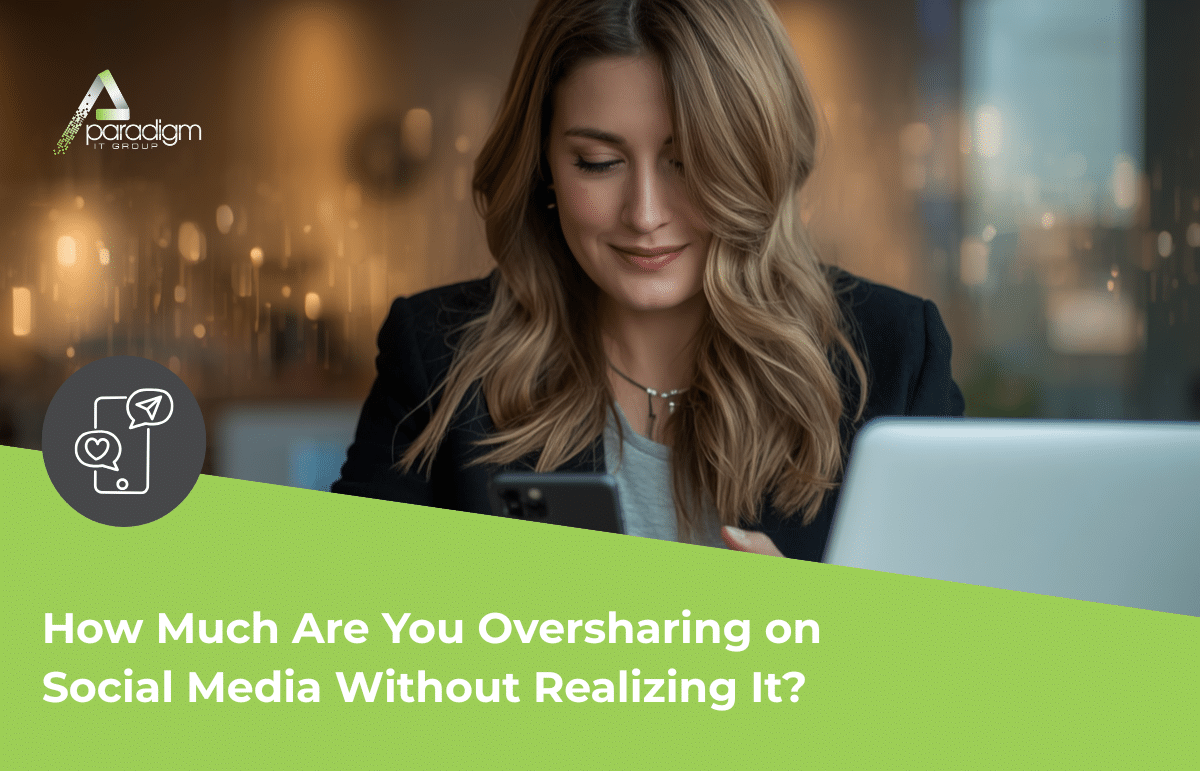
How much does a cybercriminal actually need to target you or one of your employees? Less than you’d think — and most of it is already sitting on your public profiles.
We’re not talking about hackers running complex technical exploits. We’re talking about someone spending a couple of hours browsing LinkedIn, Facebook, and Instagram — and walking away with everything they need to send a perfectly convincing, personally crafted attack directly to your inbox.
That’s the reality of social media oversharing in 2026. And most small business owners and their teams have no idea how much they’re giving away.
Why Social Media Is a Goldmine for Cybercriminals
Social media was built to connect people. The problem is, it connects everyone — including people who want to use that information against you.
According to the FTC’s April 2026 Data Spotlight, Americans lost $2.1 billion to scams that originated on social media in 2025 alone — an eightfold increase since 2020. Nearly 30% of everyone who reported losing money to a scam said it started on social media. And for every age group under 80, social media was the costliest fraud contact method — more than phone calls, texts, and emails combined.
That number is striking. But here’s what makes it even more concerning for businesses: the FTC data captures consumer scams. It doesn’t fully account for the business-targeted attacks — the spear phishing emails, the invoice fraud, the CEO impersonation schemes — that get built from the same raw material your employees are posting every day.
The Digital Dossier: How Criminals Build a Profile on You
Think about what a cybercriminal actually needs to craft a convincing attack. They need to know who you are, who you work for, who your boss is, and what’s going on in your life right now. That’s it. The rest is just execution.
IBM Security describes this process directly: skilled attackers can craft a convincing spear phishing email after just a couple of hours of online research. They’re not guessing. They’re reading your LinkedIn headline, your Facebook check-ins, your Instagram stories, and your public connections — and they’re assembling a picture of your professional and personal life that’s more detailed than most people realize they’ve shared.
That assembled picture is what security professionals call a “digital dossier” — a profile of a target built entirely from publicly available information. And here’s what makes it so dangerous: no one had to hack anything to build it. You posted it yourself.
AI Has Made This Effortless — and Nearly Undetectable
What used to take a skilled attacker days of manual research now takes minutes. AI tools can scan multiple platforms simultaneously, cross-reference job titles with org charts, identify relationships between employees and vendors, and generate a personalized, grammatically perfect phishing message at scale.
The result: attacks that no longer have the telltale signs employees are trained to spot. No broken English. No suspicious urgency. No misspelled domain. Just an email that sounds exactly like it came from your boss, your vendor, or your bank — because it was written using real information about all three.
This is why cybersecurity awareness training can’t just cover “how to spot a phishing email” anymore. The emails look real because the research behind them is real. The defense has to start earlier — with what your team is sharing publicly in the first place.
Platform by Platform: What Criminals Are Actually Looking For
LinkedIn — Professional Reconnaissance
LinkedIn is designed for professional visibility. That’s also what makes it the most valuable research tool a cybercriminal has. Your job title, your employer, your boss’s name, your team structure, your vendor relationships, your recent promotions — it’s all there, organized and searchable.
Attackers look for employees who handle payments or have financial authority, then use the org chart to impersonate their managers. A message that says “Hey, I need you to process this invoice before close of business today — I’m in back-to-back meetings” lands very differently when the attacker already knows your boss’s name, your company, and what department you work in.
Facebook — Personal and Schedule Intelligence
Facebook is where people let their guard down. Vacation announcements tell criminals when your office is short-staffed and you’re distracted. Family milestones reveal personal details that make impersonation more convincing. Location check-ins can reveal patterns in your routine. Public group memberships signal your interests, affiliations, and sometimes your political and financial views.
One of the most overlooked risks: posting vacation photos in real time. “Heading to Disney World with the family this week!” is a public notice that you’re away from the office, likely checking email less carefully, and more likely to approve something quickly without picking up the phone to verify.
Instagram — Visual and Location Intelligence
Instagram adds a layer that the other platforms don’t: visual and audio data. Photos taken in your office can reveal equipment makes and models, visible screens, physical security setups, and layout details that help an attacker sound credible when posing as tech support or a vendor.
Location tags on posts confirm where you work, where you eat, where you travel. And video content — Reels, Stories, voice-overs — is increasingly being used as raw material for AI-generated voice cloning. If an attacker can clone a convincing version of an executive’s voice from a few publicly available clips, a fraudulent “call” asking for an urgent wire transfer becomes a real threat.
5 Habits That Reduce Your Exposure Today
- Audit your public profiles. Go to each platform right now and view your profile as a stranger would. Ask yourself: would a criminal find anything useful here? Your job title, your boss’s name, your workplace, your schedule — if it’s visible, it’s available.
- Treat LinkedIn like a front door, not an open house. Be thoughtful about how much organizational detail is visible. Connecting publicly is fine; broadcasting your full internal org chart to anyone with an internet connection is a different decision.
- Delay vacation posts. Post the photos after you’re back, not while you’re away. Real-time travel announcements are an invitation. After-the-fact ones are just memories.
- Remind your team: employees are targets, not just executives. Attackers target whoever has access. That might be your office manager who approves invoices, your IT contact who can reset credentials, or your front desk staff who can be socially engineered into opening a door — physical or digital.
- Tighten your privacy settings across all platforms. Most platforms default to maximum visibility because that serves them, not you. Take 15 minutes to review who can see your posts, your connections, your tagged photos, and your contact information. “Friends only” is not foolproof, but it raises the bar significantly.
Questions Worth Asking Your IT Team
- Do we have a social media policy that covers what employees can and can’t post about work?
- Are we running phishing simulation training that includes socially engineered scenarios — not just generic email tests?
- Have we reviewed the digital footprint of employees who handle financial transactions or system access?
- If an attacker called one of our employees impersonating a vendor or executive, would they know what to do?
If those questions don’t have quick, confident answers, that’s worth a conversation with your IT provider.
The Bottom Line
You can’t erase what’s already online, and you don’t have to disappear from social media to stay safe. But awareness is the first layer of defense — and right now, most small businesses aren’t even thinking about social media as a cybersecurity issue.
Criminals are. They’re counting on the fact that your employees post freely, your profiles are public, and nobody’s thought twice about it. Changing that doesn’t require a policy overhaul or a technology investment. It starts with a conversation — and a few minutes adjusting your settings.
The goal isn’t paranoia. It’s being a harder target than the next business on the list.
As always, your Paradigm team is just a call, email, or text away for any questions or concerns that may arise.
If you’d like us to take a look at your team’s security awareness training or help you think through a social media policy for your business, we’re here to help. No pressure, no sales pitch — just an honest conversation about where you stand.
— Angie, Oscar, and Your Paradigm Team
P.S. Want to see what a real phishing attempt looks like in 2026 — and how to spot it before it’s too late? Check out our blog: Phishing Emails 2026: What’s Changed and How to Spot Them. [Phishing Emails 2026: What’s Changed and How to Spot Them]