
Nobody Can Open the Lockbox But Them: What Email Encryption Is and Why Your Business Should Care
Most business owners we talk to assume their email is secure. And honestly, that assumption makes sense — you’ve got a reputable platform, maybe Microsoft 365 or Google Workspace, you have antivirus running, and your IT provider set everything up properly. That should cover it, right?
Here’s the distinction that tends to catch people off guard about email encryption for business: your email platform being secure means someone can’t break into your inbox. Email encryption is something different. It’s about what happens to the message itself after you hit send — while it’s traveling across the internet, passing through servers, on its way to the recipient. Those are two very different problems, and most small businesses are only solving one of them.
The Best Way to Think About It
Think about sending a letter through the mail. The envelope gives you some privacy — a casual observer can’t read it at a glance. But anyone who handles that letter along the way could open it if they wanted to. The envelope isn’t a lock. It’s just paper.
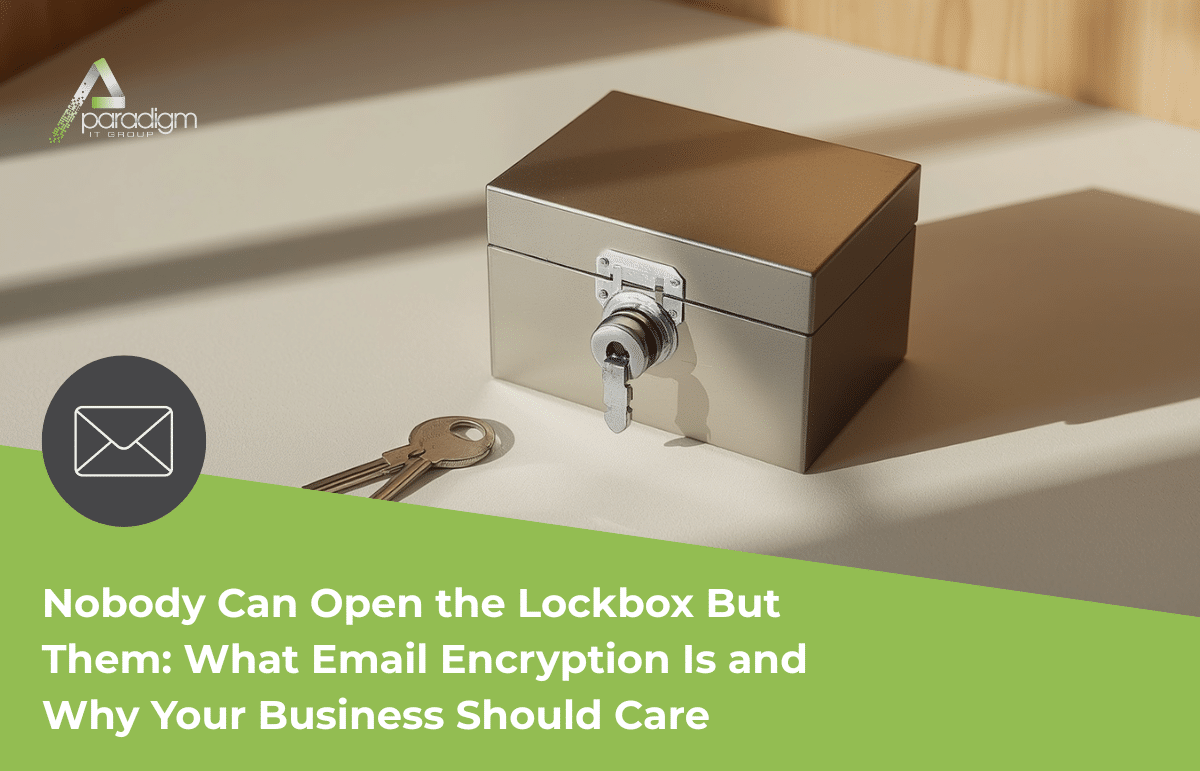
Now imagine instead of an envelope, you put that letter in a lockbox. The lockbox travels through the same hands, the same postal routes, the same stops along the way. But it doesn’t matter who touches it — only the person with the key can open it. Everyone else just sees a locked box.
That’s email encryption. The message travels the same path it always does, across the same internet infrastructure, through the same servers. But the content is locked. Without the right key, it’s unreadable — to anyone who might intercept it along the way, it’s just noise.
Think About What You Actually Send Over Email
This is where the conversation usually shifts for business owners. Because when you stop to think about it, email carries a lot more than most people realize.
Social Security numbers. Dates of birth. Signed contracts. Financial records. Insurance information. Client intake forms. Tax documents. Medical history. The kind of information that, if it landed in the wrong hands, would cause real harm to real people — your clients, your patients, your customers.
Most of that information gets sent without a second thought, because the email platform feels professional and the connection feels private. But “private” and “encrypted” are not the same thing. A standard email without encryption is closer to that paper envelope than a lockbox. The sensitivity of what’s inside should be driving the decision — not the assumption that it’s probably fine.
Who Especially Needs to Pay Attention
For some industries, email encryption isn’t just a good idea — it’s a compliance requirement.
Healthcare practices covered by HIPAA are required to protect electronic health information when it’s transmitted. The 2026 HIPAA Security Rule update — expected to be finalized in mid-2026 — is set to make encryption mandatory for electronic protected health information both at rest and in transit, removing the long-standing flexibility that allowed smaller practices to document an alternative instead of implementing it. Even before that rule is finalized, encryption of patient data in transit is already a HIPAA expectation. A medical practice emailing a patient’s records, test results, or appointment details without encryption isn’t just taking a risk. It’s a compliance exposure.
Financial services firms fall under the Gramm-Leach-Bliley Act, which requires that customer financial data be encrypted in transit. That means accounting firms, financial planners, insurance agencies, and similar businesses have a legal obligation to protect the information they send over email — not just store it securely.
Real estate and title companies are a category we see this conversation come up in often. The volume of sensitive information that moves through a real estate transaction — Social Security numbers, bank account details, wire transfer instructions, signed legal documents — is significant. And because the pace of those transactions is fast, information tends to get emailed quickly without much thought given to how it’s traveling.
But the honest answer is that it’s not limited to regulated industries. Any business that regularly exchanges sensitive client information — HR documents, legal paperwork, financial records, personal data of any kind — should be asking whether that information is protected in transit. The regulation might not apply to you. The risk still does.
The Honest Tradeoff
Email encryption adds a step. We want to be straightforward about that.
Depending on how it’s set up, the recipient may need to verify their identity or use a portal to open an encrypted message. It’s not designed for convenience — it’s designed for protection. Being upfront about that is more useful than overselling it as seamless.
That said, the experience has improved considerably. Many modern setups allow encryption to trigger automatically based on rules — if a message contains a Social Security number, certain keywords, or is being sent to a specific type of recipient, it encrypts without anyone having to remember to turn it on. The goal is to make it as seamless as possible while ensuring the protection is actually in place. Your IT provider should be able to walk you through what that looks like in your specific environment.
Questions Worth Asking
You don’t need to become an encryption expert. But there are a few things worth knowing about your own setup.
Do you know whether your current email environment includes encryption? Not just secure login, not just spam filtering — but actual message-level encryption for sensitive outbound email. Do you know what triggers it, if it’s there at all? Is your team aware of when they should be using it?
If you’re in healthcare, financial services, real estate, legal, or HR — or if your business regularly handles personal data of any kind — those questions have compliance implications. If you’re not sure of the answers, that’s worth a conversation with your IT provider before it becomes a problem.
The Bottom Line
The information your clients share with you — their records, their finances, their personal details — they’re trusting you to handle it with care. The lockbox analogy exists for a reason: it’s not enough that the information starts in a secure place. It needs to stay protected on the way there.
Email encryption is one of those things that most small businesses haven’t fully thought through yet. That’s not a criticism — it’s genuinely not obvious, and the platforms do a good job of feeling more secure than the underlying reality sometimes is. But it’s worth knowing where you stand.
As always, your Paradigm team is just a call, email, or text away for any questions or concerns that may arise.
If you’d like us to take a look at your current email setup and walk you through what encryption looks like in your environment, we’re happy to do that. No pressure, no sales pitch — just an honest conversation about where you stand.
— Your Paradigm Team
P.S.
Email security is one layer of a larger picture. If you haven’t already, [SSL Certificate blog] is a good companion read — it covers how your website connection stays protected, which works alongside email encryption to keep client communications secure end to end.